
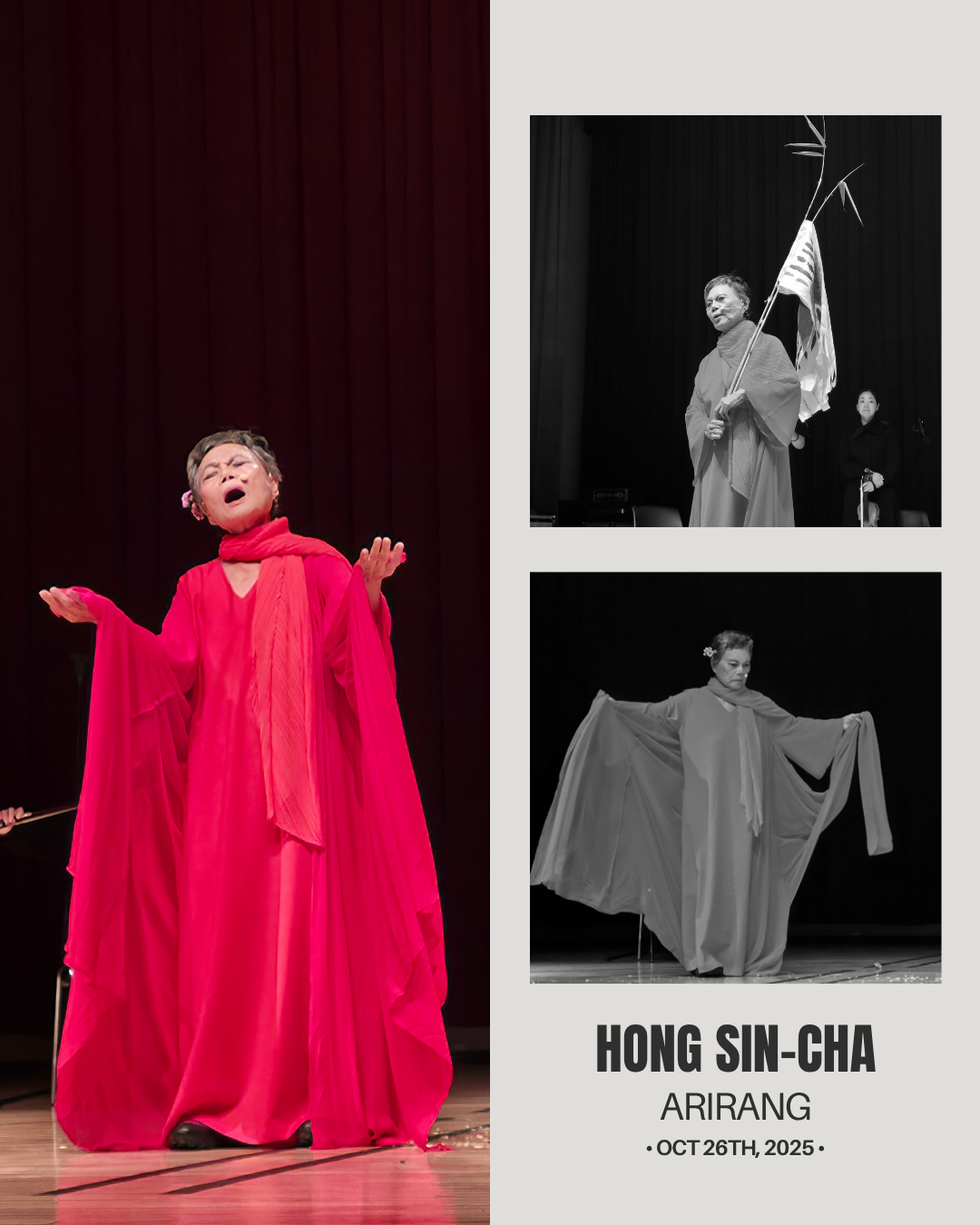
On Sunday, October 26, the Goseong Cultural Welfare Center became a space where art quietly crossed boundaries. Hong Sin-Cha’s Arirang was more than a performance. It was a meditation on history, sorrow, and peace. The audience gathered in silence, drawn to the magnetic presence of Hong Sin-Cha, a name deeply rooted in the history of Korean avant-garde dance.
Born in 1940 in Chungnam, Hong Sin-Cha is widely known as Korea’s first experimental performance artist, a meditator, and a writer. After graduating from university in Korea, she moved to the United States and made her dance debut at the age of 28, relatively late by professional standards, yet her impact was immediate. The New York Times praised her work as “a revelation of disciplined freedom,” setting the stage for her international acclaim.
Her journey later took her to India, where she became a disciple of Osho Rajneesh. Through years of meditation, she came to see the body not just as a tool of expression, but as a vessel of consciousness. When she returned to the stage, she founded the Laughing Stone Dance Company and began collaborating with artists like John Cage, Margaret Leng Tan, and Nam June Paik. Together, they reimagined performance art as a living philosophy that fused movement, sound, silence, and presence.
At 71, Hong entered another chapter of her life when she married Werner Sasse, a German scholar of Korean studies. Their union symbolized harmony between East and West, intellect and intuition, tradition and modernity. Over the years, she has also shared her philosophy through writing, in works such as I Want to Give You Freedom Too, The Freedom to Do Anything, the Freedom to Do Nothing, I Lived the Moment Like Dancing, and An Apology for Freedom. Each one reflects her belief in living and moving with honesty, courage, and surrender.
Her recent performance in Goseong carried this same spirit. The choreography was minimal, but every gesture was precise and full of life, refined through decades of practice. The live music, played on haegeum, guitar, violin, and percussion, was fully improvised, following her rhythm of breath. Between motion and stillness, structure and spontaneity, a deep resonance emerged.
For the audience, time seemed to slow down. Even moments of stillness felt alive, as if silence itself was dancing. Some viewers wiped quiet tears, while others lingered after the performance, reluctant to break the atmosphere that had enveloped the hall.
The setting added a layer of meaning. Goseong, located near the border between North and South Korea, holds the scars of division and the longing for reunification. Once separated by the Demilitarized Zone, it has become a place where history, memory, and hope intersect. To witness Arirang – a song of both sorrow and resilience – performed here by Hong Sin-Cha, was profoundly symbolic. Through her body, Goseong’s quiet landscape transformed into a bridge of connection, turning the pain of separation into a shared prayer for peace.
More than sixty years into her artistic journey, Hong Sin-Cha continues to remind us that art is not about spectacle or entertainment. It is about awakening, returning to what is most human within us, through a single step, a breath, or a pause.
During the post-performance Q&A session, one audience member asked Hong Sin-Cha, “What is art to you?” Without a moment’s hesitation, she replied, “Art is oxygen to me. Just as we cannot live without air, our souls cannot truly breathe without art.”
When the audience learned that the entire one-hour performance had been an improvisation, they were astonished. The musicians explained, “Some of us met for the first time today, yet through rhythm, sound, and the exchange of glances, we were able to connect our spirits and create harmony under Hong’s subtle guidance.”
In that moment, the stage became more than a performance, it became a vision. Just as the hope for reunification and the yearning for freedom may one day harmonize without rigid plans or perfect coordination, perhaps through shared intention, goodwill, and open communication, that day will come like a spontaneous symphony of peace.
Oct 27 (Mon), Sanha Oh